


















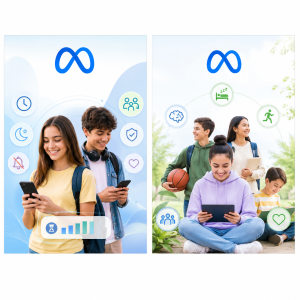
Social media is now part of everyday life for millions of children and teenagers. Platforms such as Instagram and Facebook allow young people to communicate, explore their interests, express themselves, and stay connected with friends and family.
The challenge is not necessarily to remove technology from their lives. It is to help young people develop a healthier and more balanced relationship with it.
A recent agreement involving Meta and a broad coalition of U.S. attorneys general introduces new protections for users under 18. While much attention has focused on the financial aspects of the agreement, its potential impact on the health and well-being of children and teenagers may be far more meaningful to families.
Protecting Sleep
One of the most important benefits involves sleep.
Social media can make it difficult for young people to disconnect at night. A notification, message, video, or new post can easily turn a few additional minutes online into a much longer period of screen time.
Under the new protections, access and notifications will be restricted during certain overnight hours for minors.
Creating a clearer separation between social media and bedtime may encourage healthier sleep routines.
Adequate sleep is particularly important during childhood and adolescence. It supports learning, memory, attention, emotional regulation, physical development, and overall well-being.
In this sense, helping young people put their phones aside at night is more than a digital rule. It can become a healthy habit.
Reducing Excessive Screen Time
Another important measure is a default daily time limit for minors using Instagram and Facebook.
The goal is not to suggest that all screen time is harmful. Young people use technology for education, communication, entertainment, creativity, and many other valuable activities.
The concern is balance.
Long periods spent scrolling through social media can displace other activities that are essential to a healthy lifestyle, including physical activity, outdoor recreation, face-to-face interaction, reading, hobbies, family time, and sleep.
A built-in limit can help young people become more aware of how much time they spend online.
Fewer Digital Interruptions
The protections also include restrictions on notifications during school hours.
Notifications are specifically designed to attract attention. For a student trying to listen to a teacher, complete an assignment, read, or study, repeated alerts can create constant interruptions.
Reducing those interruptions may help young people maintain their attention for longer periods and develop healthier habits around their phones.
Technology can remain an important educational tool without demanding a student’s attention every few minutes.
Less Pressure From Likes and Reactions
Social media can sometimes turn popularity into a number.
Young people may compare how many likes, reactions, or comments their posts receive with those received by friends or other users.
Under the new measures, certain engagement counts will be hidden by default for minors.
Removing some of the visibility surrounding these numbers may reduce the pressure to constantly seek digital approval.
For children and teenagers who are still developing their identities and self-confidence, the message is important: Personal value should not be measured by the number of reactions received online.
Supporting a Healthier Body Image
The agreement also addresses certain filters that dramatically alter physical appearance or simulate cosmetic procedures.
Digital filters can be entertaining and creative, but highly altered images can also blur the distinction between someone’s natural appearance and a digitally manufactured version of it.
Children and teenagers are developing their perceptions of themselves during particularly important years.
Reducing exposure to extreme appearance-altering tools may encourage a more realistic understanding of physical appearance and help reduce unnecessary pressure to meet digitally created standards.
More Control Over What Young People See
Another significant change involves giving users greater control over how content is presented.
Social media algorithms can be extremely effective at identifying what attracts a person’s attention and then showing similar material repeatedly.
Greater access to alternatives that are less dependent on algorithmic recommendations may help young people and their families exercise more control over their digital environment.
This introduces an important principle of digital wellness: technology should serve the user, rather than constantly compete for the user’s attention.
Giving Parents Better Tools
The new protections also strengthen parental controls.
Parents will have more opportunities to establish limits and participate in certain decisions regarding their children’s social media settings.
These tools should not replace conversations between parents and children. Instead, they can provide an opportunity to discuss why sleep matters, why taking breaks from screens is healthy, how online comparisons can affect us, and why some content deserves caution.
Parental control can therefore become something broader: parental guidance and digital health education.
Protecting Younger Children
Stronger age-verification or age-estimation systems are also part of the effort.
This is important because protections designed for minors cannot work effectively when children can easily misrepresent their age when creating an account.
Better age detection could help ensure that younger users actually receive the protections intended for them.
A Shared Responsibility for Digital Health
Families have an important responsibility for teaching children healthy technology habits. Schools can help students develop digital literacy and responsible online behavior. Young people themselves must gradually learn to manage their time and make thoughtful decisions.
But technology companies also have a role.
When platforms are used by millions of children and teenagers, designing features that consider their age, development, sleep, attention, and emotional well-being can become an important part of creating a healthier digital environment.
The Goal Is Balance, Not Isolation
Social media can provide meaningful benefits. It can connect young people with friends and relatives, provide access to information, encourage creativity, and help them discover communities and interests.
The objective should not be to portray technology as the enemy.
The healthier approach is to teach young people that there should be a time to connect and a time to disconnect; a time for screens and a time for sleep, exercise, school, family, friends, and the world beyond the phone.
That may ultimately be the most important benefit of these new protections.
Their success should not be measured only by regulations or financial settlements, but by whether they help create a digital environment in which children and teenagers can enjoy the benefits of technology without allowing it to dominate their sleep, attention, self-image, and everyday lives.