












Autor y fotos: Prof. Sebastián A Chiapella y sus alumnos
Colegio Schönthal A-581
Av. Nazca 537 – Ciudad de Buenos Aires – Argentina
Tel: 4637-1414
correo@schonthal.esc.edu.ar
www.schonthal.esc.edu.a
When Childhood Toys Enter the Science Laboratory
Abstract
For several weeks, we studied geological eras and the dinosaurs of the Triassic, Jurassic, and Cretaceous periods with a group of first – year secondary school students at Colegio Schönthal in Buenos Aires, Argentina. The students were 13 years old. As part of this learning process, I invited them to bring to the laboratory any dinosaur toys they had at home so that we could observe them, compare their characteristics, and relate them to what we had been learning. As they worked in groups, prepared comparative tables, and discussed possible confrontations between dinosaurs, the conversations surrounding the toys also gave rise to stories about birthdays, family gifts, and childhood games. The activity went beyond what I had initially expected. In addition to providing an opportunity to work on scientific content, the toys became a way for students to share personal stories and revisit experiences from earlier moments in their lives. In the following days, some students spontaneously returned to the characteristics we had studied and the conversations we had shared during that class. What happened invites us to reflect on the role that memories and emotions can play in science education.
An Idea That Emerged in the Laboratory
As we progressed in our study of the Mesozoic Era, we learned about the characteristics of dinosaurs from the Triassic, Jurassic, and Cretaceous periods. We examined photographs, watched videos, and organized information into comparative tables to identify their similarities and differences. I began to notice the enthusiasm with which the students approached the subject. Our classes prompted questions, comments, and discussions, and I started thinking about how we could make use of this interest to continue exploring what we had learned in a different way. Then I asked myself:
What would happen if the dinosaur toys that had been part of my students’ childhoods became a tool for learning science?
I came up with the idea of asking them to look for the dinosaur toys they had kept at home and bring them to school. Having the toys in front of us would allow us to observe their shapes, compare their characteristics, and revisit what we had studied. But I also imagined that these 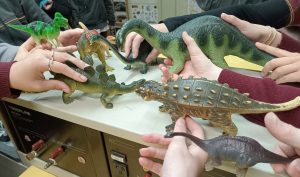 objects might hold personal stories: memories of birthdays, family gifts, and games from earlier years. I wanted to bring these experiences together with the knowledge we had been building in class and discover what might emerge from that encounter.
From Toys to Scientific Inquiry
On the day of the activity, some students arrived with several dinosaurs, while others were unable to bring any. Nevertheless, together we assembled a wide variety of figures. I suggested placing them on one of the laboratory’s large workbenches so that we could all observe them.
As the students began taking out their toys and showing them to their classmates, I asked whether they remembered how long they had owned them. I also commented on how lovely it was that they had kept toys from when they were little. Stories soon began to emerge:
“My grandfather gave me this one,” “I got this one for my birthday,” “Santa Claus brought me this one.”
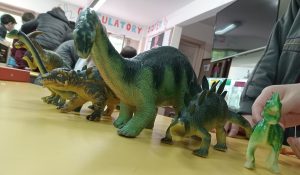 One student explained that he had taken a dinosaur toy to preschool when he was little and had recently found it again after years of not seeing it. He had started looking for it when I suggested bringing the toys to school. As each student showed their toys, family stories and memories of games that had remained tucked away for years began to emerge. The dinosaurs were no longer just figures to observe; they were also connected to people, gifts, and moments from childhood. The situation made me think about how an everyday object can become a gateway to personal memories that take on new meaning when shared with others.
During that class, the stories emerged spontaneously from the toys and the conversation that developed around them. We then began organizing the figures, bringing together those that represented the same type of dinosaur and placing them in different areas of the workbench. Once they were grouped, we selected figures to examine their characteristics. We revisited what we had studied: what the dinosaurs ate, where they lived, how large they were, what their jaws and teeth were like, and which adaptations might be related to their diets and ways of life. We also discussed the places where their fossil remains had been found.
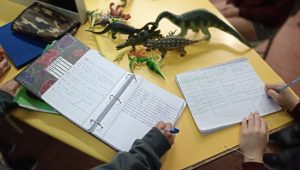
Each group then prepared comparative tables in their notebooks. The students passed the toys around so that everyone could examine the different figures and record the same characteristics. While some examined a figure, others consulted their notes or compared what they observed with the knowledge they had developed in class. The toys had thus become tangible materials for observation, comparison, and the retrieval of information.
Once we had completed the tables, I suggested that the students organize imaginary battles between the dinosaurs. We divided the class into two groups. In turn, one student from each group chose a figure to face one selected by a classmate. The idea was not simply to decide which dinosaur seemed stronger, but to justify their choices based on the characteristics we had studied.
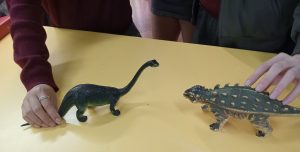 The discussions began immediately. The Tyrannosaurus rex had many supporters because of its jaws and teeth, while others emphasized the size of the Diplodocus and the force they imagined its long tail might have. Amid laughter and comments, students defended their choices and debated which characteristics might give one dinosaur an advantage over another. To support their arguments, they had to revisit what they had learned and use it to explain their ideas. To conclude the activity, we gathered in front of the board, where we had prepared a diagram of the Mesozoic Era that we needed to complete with the dinosaurs we had
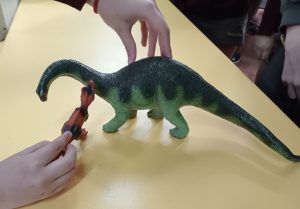 studied. The students took turns using the markers to place the different dinosaurs in the appropriate positions. In this way, we brought together the knowledge developed throughout the lessons and related it to what we had observed, compared, and discussed.
What Remained After the Experience
When the bell rang, the students were very happy, and several stayed a little longer to play with the dinosaurs. I had the impression that the activity had brought back something of those childhood games. Even after examining the figures and discussing their characteristics from a scientific perspective, they still wanted to play with them. At the end, they expressed their appreciation for the experience, and several told me they would like to have another class like it, in which they could investigate, share memories, and play with the dinosaurs while learning.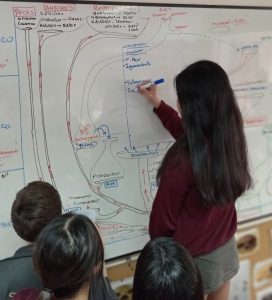
The following day, as I was walking along one of the school corridors, I met a group of students who had taken part in the activity. One of them took out a dinosaur he was still carrying and said to me:
“Do you remember the dinosaurs from yesterday? This is a T. rex. It’s the most powerful of them all.”
As we talked, he held the toy in his hand and played with it during recess. I was struck by the fact that he had returned to the conversation from the previous day and remembered some of the characteristics we had discussed during the imaginary battles. I was also left thinking about what one student had said at the end of the activity. She explained that playing again with the dinosaurs she had owned as a little girl had given her a wonderful feeling. According to her, she would not have started playing with them on her own at home, but at 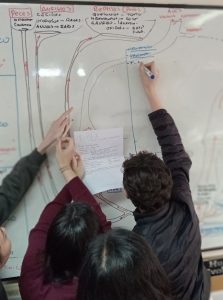 school, by sharing the experience with her classmates and working with the toys from a scientific perspective, she had found an opportunity to do so again. I found this comment particularly meaningful. The activity had allowed her to reconnect with something from her childhood in a context that also invited her to observe, compare, and learn. These situations led me to think about the relationship between emotions, play, and scientific learning. The dinosaurs had not been merely objects for identifying anatomical characteristics, comparing feeding habits, or discussing possible advantages in an imaginary confrontation. They were also toys connected to personal stories, capable of evoking memories and generating enthusiasm for a shared activity. In this context, playing and studying were not opposing activities: the students were able to observe, investigate, and argue while continuing to enjoy the game. The stories about family gifts and games from earlier years also made me think about the relationship between objects and personal memories.
Fivush (2011) examines the development of autobiographical memory and highlights the importance of social and cultural contexts in the construction of memories. Without attempting to explain how each student’s memory works on the basis of this experience, I believe that what happened illustrates how a familiar object can become an opportunity to recall and share personal experiences in a shared setting. Pessoa (2008), in turn, argues that emotional and cognitive processes interact and cannot be understood as completely separate systems.
From this perspective, the experience allows us to recognize that working with scientific content can also involve memories, emotions, and interactions with classmates. In our activity, these dimensions were present as students examined the dinosaurs, discussed their characteristics, and shared personal stories. Although we cannot claim that emotions caused what the students learned or remembered, they were part of an experience that combined scientific work, enjoyment, and social interaction. Another aspect that interested me was the enthusiasm the students already showed for dinosaurs and the possibility of drawing on that interest to offer a different way of exploring the subject.
Hidi and Renninger (2006) explain that interest can be triggered in a specific situation and, under certain conditions, maintained and developed. In our experience, observation, comparison, play, and argumentation offered different opportunities to sustain participation and connect scientific content with an experience close to the students’ lives.
We cannot claim that a single activity generated lasting interest, but it did allow us to work with the content through an approach that involved the students personally. What happened the following day also led me to reflect on how knowledge explored in class might reappear in other situations. During the imaginary battles, the students had needed to draw on the dinosaurs’ characteristics to justify their choices. Seeing one of them spontaneously return to that conversation during recess made me consider the possibility that the activity had left something beyond the memory of an enjoyable class: some of the content we had studied was still present in a play situation.
Agarwal et al. (2021), in a systematic review of research conducted in schools and classrooms, found that retrieval practice can benefit learning. Although our activity was not designed to evaluate this effect, what happened allowed me to recognize that some of the content could reappear spontaneously after the class. However, we did not conduct an assessment that would allow us to determine how much the students learned or how long they would retain that knowledge. Nor can we attribute this retrieval to emotions or play alone. This experience left me with a reflection that I consider important for teaching:
When scientific content is explored through objects that are familiar to students, new opportunities may arise for participation, recalling what they have learned, and finding meaning in the learning process.
References
Agarwal, P. K., Nunes, L. D., & Blunt, J. R. (2021). Retrieval practice consistently benefits student learning: A systematic review of applied research in schools and classrooms. Educational Psychology Review, 33, 1409–1453. https://doi.org/10.1007/s10648-021-09595-9
Fivush, R. (2011). The development of autobiographical memory. Annual Review of Psychology, 62, 559–582. https://doi.org/10.1146/annurev.psych.121208.131702
Hidi, S., & Renninger, K. A. (2006). The four-phase model of interest development. Educational Psychologist, 41(2), 111–127. https://doi.org/10.1207/s15326985ep4102_4
Pessoa, L. (2008). On the relationship between emotion and cognition. Nature Reviews Neuroscience, 9, 148–158. https://doi.org/10.1038/nrn2317